

Introduction
Salesforce Agentforce matters because enterprise teams do not need another isolated chatbot; they need an execution surface that can reason over business context, stay inside platform controls, and complete work across Salesforce workflows. In practical terms, that means combining language understanding with CRM records, metadata, automation, and operational policy. The most useful framing is to treat Agentforce as an orchestration layer sitting between human intent and governed business actions.
For architects, admins, and developers, the design question is not whether an LLM can produce fluent output. The harder question is how you bound that output with trusted data, deterministic automations, explicit approvals, and observability. This guide focuses on the implementation tradeoffs, runtime boundaries, and delivery decisions that shape devops work in Agentforce. That is why successful Agentforce implementations start from architecture, identity, and process design before they focus on polished conversational experiences.
A strong DevOps implementation usually follows the same pattern: define the business objective, identify the records and actions the agent can use, design prompts that encode policy and tone, expose actions through Flow or Apex, and then measure outcomes with operational telemetry. This pattern keeps the solution explainable and creates a handoff model that admins, architects, developers, and service leaders can all understand.
Architecture explanation
Production deployment architecture matters because agent systems are living systems. You are not just shipping HTML and Apex; you are shipping prompts, permissions, monitoring, rollback procedures, and behavior contracts that need disciplined change control.
Salesforce DX guidance and newer Agentforce Builder workflows both point to the same production principle: agents are metadata and should move through source control, test environments, pilot cohorts, and monitored production releases with clear rollback options.
Deploying Agentforce to Production works best when the architecture separates conversational intent from deterministic execution. Topics and instructions tell the agent what kind of work it is doing. Grounding layers bring in trusted business facts from Salesforce data, knowledge, Data Cloud, or external systems. Actions then convert the plan into platform work through Flow, Apex, or governed API calls. Trust controls wrap the entire path so data access, generated output, and side effects remain observable and policy-bound.
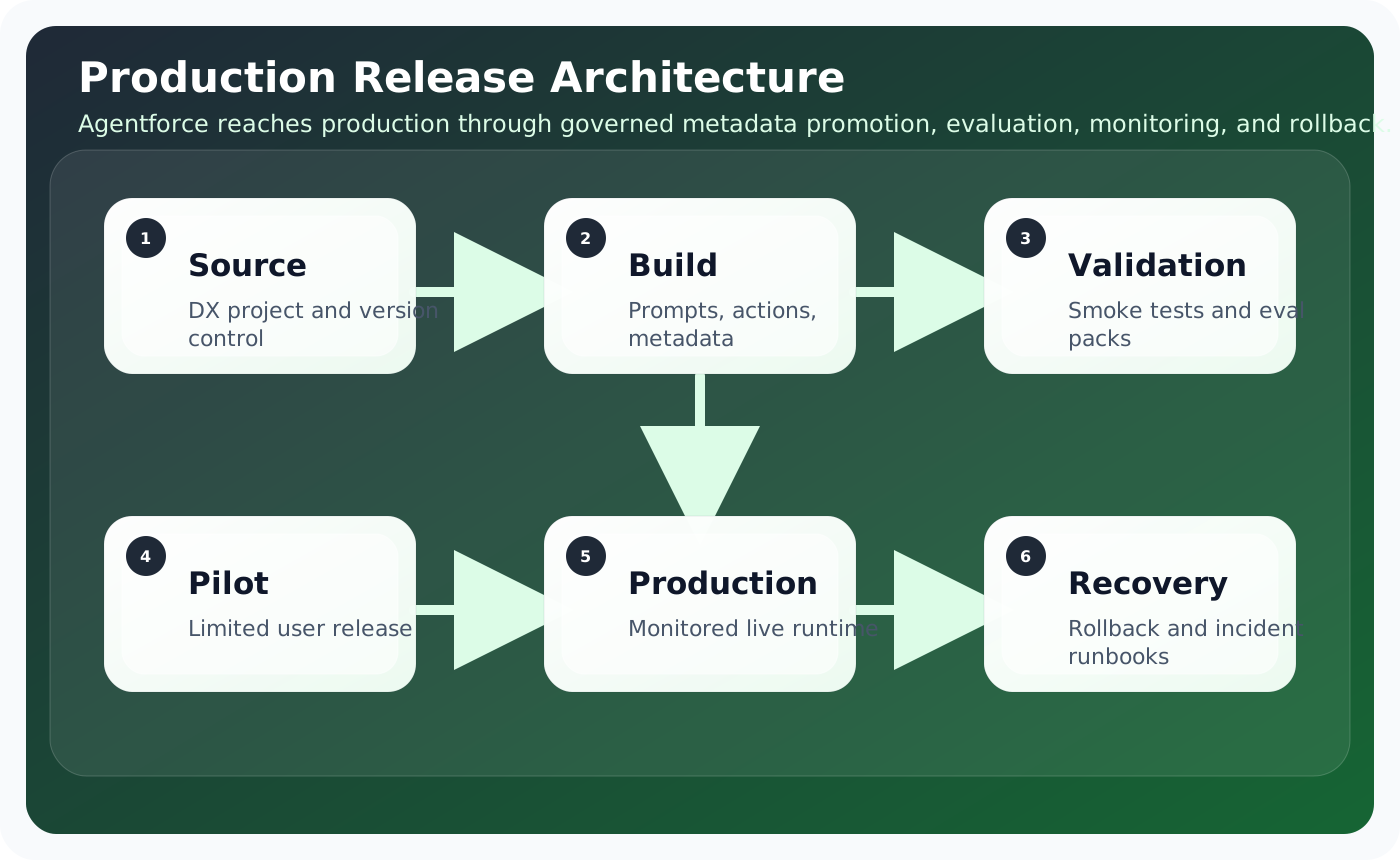
These layers are useful because they help teams decide where a problem belongs. If the answer is wrong, the issue may sit in grounding. If the action is unsafe, the problem sits in permissions or execution validation. If the result is verbose or inconsistent, the issue is often in prompting or output schema. Separating the architecture this way keeps debugging concrete, which is essential when an implementation grows across multiple teams.
In enterprise delivery, it also helps to think about control planes versus data planes. The control plane contains metadata, prompts, access policy, model selection, testing, and release procedures. The data plane contains the live customer conversation, retrieved records, outbound actions, and operational telemetry. This distinction prevents teams from mixing authoring concerns with runtime concerns and makes promotion across sandboxes significantly easier.
The most reliable Agentforce implementations keep the model responsible for reasoning and language, while deterministic platform services remain responsible for data integrity, approvals, and side effects.
Step-by-step configuration
Configuration work succeeds when the team treats Agentforce setup as a sequence of platform decisions rather than a single wizard. The steps below reflect the order that keeps dependencies visible and avoids rework later in the release.
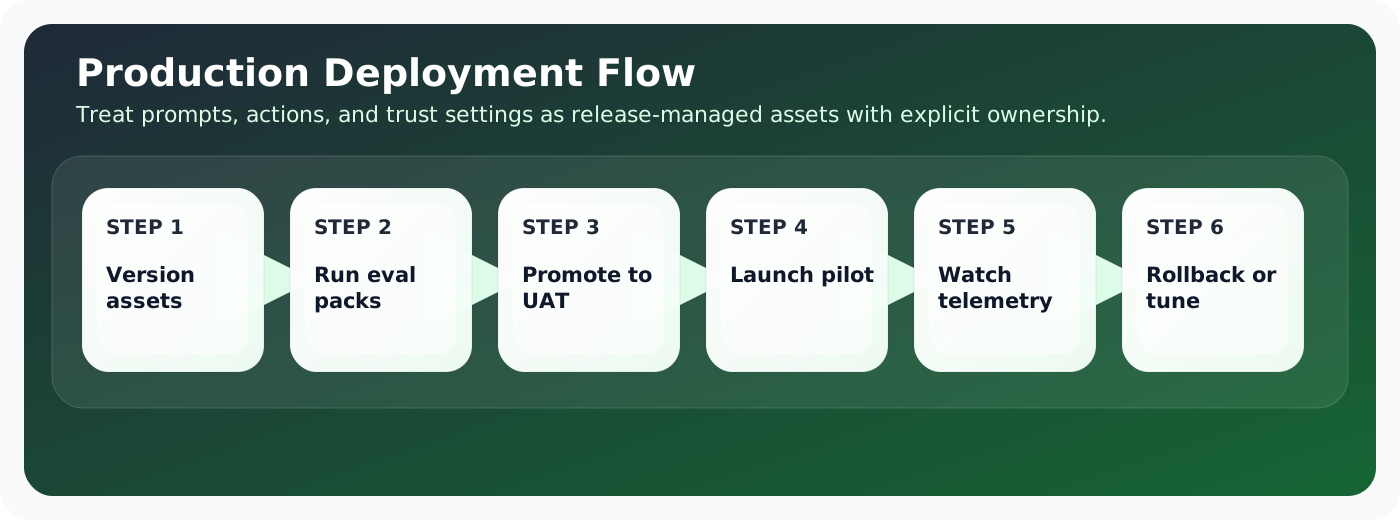
The production rollout flow makes release discipline visible: version assets, run evaluation packs, promote to a pilot, monitor live behavior, and be prepared to roll back. Agentforce behaves much better when those steps are explicit and repeatable.
- Separate development, test, and production environments and treat prompts and action definitions as release-managed assets.
- Create smoke tests for the highest-value user journeys and include both answer quality and action safety checks.
- Define rollback procedures for prompts, flows, Apex, and integration credentials before the first release.
- Implement observability for conversation volume, task success, latency, escalation rate, and policy violations.
- Train operational owners on what they can tune in metadata versus what needs code or security review.
- Release to a limited cohort first, then expand based on measured stability and support readiness.
- Run post-release reviews to update prompts, controls, and runbooks with production evidence.
Production readiness also includes ownership on the human side. Decide who watches the dashboards, who receives escalations when action failures spike, and who can temporarily disable an unsafe capability. Operational clarity is part of the architecture, not an afterthought.
Code examples
Enterprise teams need concrete implementation patterns because agent behavior eventually resolves into platform metadata and code. Production readiness depends on release metadata and evaluation packs as much as on prompts and actions. These examples show the artifacts teams should promote and verify.
Deployment manifest example
release: agentforce-wave-3
environments:
  - name: uat
    prompts:
      - support-resolution-v5
      - escalation-summary-v3
    actions:
      - update_case_status
      - get_shipment_status
  - name: production
    rollout: canary
    pilotUsers:
      - service-ops-supervisors
      - tier2-support
Smoke evaluation pack
{
  "suite": "production-readiness",
  "tests": [
    "case-summary-quality",
    "escalation-policy-compliance",
    "shipment-api-timeout-fallback",
    "pii-redaction-check"
  ],
  "passCriteria": {
    "minimumSuccessRate": 0.95,
    "zeroCriticalPolicyViolations": true
  }
}
Operating model and delivery guidance
Agentforce projects become easier to sustain when the delivery model is explicit. Administrators typically own prompt authoring, channel setup, and low-code automations. Developers own custom actions, advanced integrations, and test harnesses. Architects own the capability boundary, trust assumptions, and release model. Service or sales operations leaders own business acceptance and the definition of success.
That separation matters because long-term quality depends on ownership. If everyone can tune everything, nobody can explain why behavior changed. If prompts, flows, and actions are versioned with release notes, then a regression can be traced back to a concrete modification. This is the same discipline teams already apply to code; Agentforce just expands the surface area that needs that discipline.
It is also useful to define an evidence loop. Capture representative transcripts, measure action success rate, compare containment against downstream business metrics, and review edge cases at a fixed cadence. Over time, this evidence loop becomes more valuable than intuition. It tells you whether a prompt change improved quality, whether a new action reduced manual effort, and whether an escalation rule is too sensitive or too lax.
Teams should also decide how documentation, enablement, and support ownership work after launch. A static runbook for incident handling, a changelog for prompt revisions, and a named owner for every high-impact action are simple controls that prevent ambiguity when the agent starts operating at scale.
Best practices
- Promote prompts with the same discipline as code.
- Define rollback before launch.
- Use canary releases for risky behavior changes.
- Give support teams runbooks, not just admin screens.
- Review production conversations to continuously tune quality.
Conclusion
Production deployment is where Agentforce stops being an experiment and becomes a service capability. The difference is not only testing; it is release discipline, rollback planning, observability, and clear operational ownership. When those pieces exist, teams can improve the agent confidently over time instead of fearing each change. Mature teams also document who can pause unsafe behavior, how prompts roll back, and how production evidence feeds the next release.
For Salesforce teams, the practical lesson is consistent: start from business flow, ground the model on trusted enterprise context, expose only the actions you can govern, and measure what the agent actually changes in production. That is how Agentforce becomes a durable platform capability instead of a short-lived proof of concept.